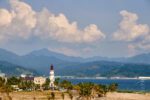

Subic Old Parola: Timeless Stories Along Subic Bay
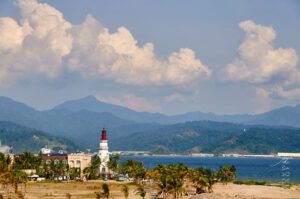
Travelers cruising along the national highway near Kalaklan Point in Olongapo City may suddenly notice a simple, all-white tower rising against the deep blue waters
Subic Spanish Gate, located along Sampson Road near Dewey Avenue in Olongapo City, was built in 1885 as the western entrance to the Spanish naval station known as Arsenal de Olongapo. Its purpose went beyond welcoming visitors — it was a defensive structure, reinforced with gun ports and connected to walls that controlled access to the bay. The Spanish recognized Subic Bay as a naturally protected harbor, and the gate’s construction reflected the importance of securing the Philippines’ strategic maritime foothold in the late 19th century.
ABOVE: The Subic Spanish Gate, a resilient symbol of Subic Bay’s naval history, has endured through centuries of historical events, transitions of power, and shifts in ownership from Spanish to American and Filipino control, now standing as a cherished historical landmark inviting reflection on the region’s diverse and dynamic past.
ABOVE: A low-angle panoramic shot captures the majestic Subic Spanish Gate, embodying its historical significance amidst the scenic Subic Bay Freeport Zone in Olongapo, Zambales.
The gate has witnessed successive eras of Philippine history. Spanish authorities maintained it from 1885 until the Philippine Revolution in 1898, when Filipino forces took control. Soon after, the Americans occupied Subic in 1899, developing it into one of the largest U.S. naval bases outside the continental United States. During these transitions, the Spanish Gate continued to serve both as an entrance and, at times, as a detention area under Spanish and American administrations. After the base’s closure in 1992, control returned to the Philippines, and the surrounding Subic Bay Freeport Zone grew into a bustling economic and tourism center, with the gate standing as a quiet sentinel to history.
ABOVE: Despite the ravages of time and wars, the Subic Spanish Gate endures as a poignant reminder of its glorious past, captured in detailed shots showcasing its historical resilience amidst ruins.
ABOVE: Through the guard holes, one can glimpse cannons, offering a unique perspective on historical defenses.
ABOVE: The Subic Spanish Gate, located in the Subic Bay Freeport Zone, is a popular spot for history enthusiasts. It stands as a reminder of the Philippines’ colonial past and the lasting influence of Spanish rule.
From a traveler’s perspective, the Subic Spanish Gate captures a unique charm. Constructed from local stone with classic masonry, the gate presents a rugged yet striking façade that contrasts with the modern Freeport surroundings. Walking through the archway, visitors can almost feel the weight of colonial ambition, revolutionary spirit, and military strategy etched into its walls. The gate is more than a photo opportunity; it offers context, connecting tourists to the narratives of Spanish colonial expansion, Filipino resistance, and American military influence.
ABOVE: The Subic Spanish Gate was designated a historical landmark by the National Historical Commission of the Philippines on November 26, 2013, with a marker inscribed “Himpilang Pandagat ng Look ng Subic” (“Naval Station of Subic Bay”).
ABOVE: Multiple photos capture the cannon positioned alongside the historic Subic Spanish Gate.
In 2013, the National Historical Commission of the Philippines formally recognized the gate as a historical landmark. A marker reading “Himpilang Pandagat ng Look ng Subic” commemorates its role in Olongapo’s naval history and its enduring cultural significance. This acknowledgment ensures that visitors, whether history enthusiasts or casual travelers, can appreciate the gate not only for its visual appeal but also as a documented piece of national heritage.
RELATED STORIES

Travelers cruising along the national highway near Kalaklan Point in Olongapo City may suddenly notice a simple, all-white tower rising against the deep blue waters


Located within the pristine Subic Bay Freeport Zone in Zambales, Ocean Adventure stands as the Philippines’ first open-water marine theme park. Surrounded by lush rainforest



Located within the pristine Subic Bay Freeport Zone in Zambales, Ocean Adventure stands as the Philippines’ first open-water marine theme park. Surrounded by lush rainforest


Subic bay is well known for its collection of shipwrecks from the past, as well as being visited frequently by the American Navy for military


ABOVE: A long-angle shot captures the majestic arch of the Subic Spanish Gate, embodying centuries of history and enduring beauty.
For modern visitors, the gate sits at the intersection of heritage and contemporary tourism. The surrounding Subic Bay Freeport Zone offers adventure parks, eco-tourism activities, and beaches, yet the gate provides a quiet, reflective pause in the midst of recreation. Photographers and history-minded travelers alike can linger, capturing the texture of centuries-old stonework while contemplating the layers of stories embedded in its walls. In this way, Subic Spanish Gate is not just a remnant of the past — it is a doorway into the Philippines’ complex and vibrant history.


ABOVE: A wide-angle shot captures the Subic Spanish Gate prominently from the roadside, revealing its ancient architecture against the backdrop of Subic Bay’s serene landscape.
I’m looking forward to the stories and images leaving a lasting positive impression on you, just as they have on me. Stay connected with us on social media for a weekly exploration of travel assignments and breathtaking visuals. Our focus is on championing local tourism, showcasing small businesses, and honoring the magnificence of the Philippines through the content we curate. Join us in spreading the word by clicking the ‘share’ buttons below. Your support means the world to us.
EXPLORE MORE about


There is no way anyone can ignore the beauty of Pamatawan River if they are traveling in the area of the coast of Pundaquit in


Along the Waterfront Road of Subic Bay Freeport Zone in Zambales, The Lighthouse Marina Resort rises as both a hotel and a visual landmark that


Located within the pristine Subic Bay Freeport Zone in Zambales, Ocean Adventure stands as the Philippines’ first open-water marine theme park. Surrounded by lush rainforest


The journey to Camara Island begins at Pundaquit, a coastal barangay in San Antonio, Zambales, where small bancas line the shore ready to ferry island-hoppers


The first thing that strikes you about Capones Island rising off the west coast of Luzon is its silhouette — a bone‑shaped landmass of rock


Travelers cruising along the national highway near Kalaklan Point in Olongapo City may suddenly notice a simple, all-white tower rising against the deep blue waters


Subic bay is well known for its collection of shipwrecks from the past, as well as being visited frequently by the American Navy for military


Located within the pristine Subic Bay Freeport Zone in Zambales, Ocean Adventure stands as the Philippines’ first open-water marine theme park. Surrounded by lush rainforest


Located in the heart of Subic Bay Freeport Zone, Zoobic Safari is a premier destination for nature lovers and thrill-seekers. Spanning 25 hectares, this one-of-a-kind


Located within the pristine Subic Bay Freeport Zone in Zambales, Ocean Adventure stands as the Philippines’ first open-water marine theme park. Surrounded by lush rainforest


The approach always begins at Pundaquit Beach in San Antonio, Zambales. A small boat cuts across the waters of the West Philippine Sea, and slowly


Pundakit, or the Municipality of Pundaquit of San Antonio, in Zambales Province, is a fishing village that boasts a multilingual local population (Ilocano, Zambal, Tagalog)
BROWSE BY CATEGORIES
BROWSE BY PROVINCE